
With a promising, innovative technology and a new factory, Blue Cycle is working hard in the field of circularity. In fact, they are producing oil from plastic waste streams, which in turn can be used as a raw material for new plastics. Yet there are still a few
success there are still a few significant obstacles for the company. At least, especially in the Netherlands. At the moment we are running up against regulations and that sometimes feels powerless. While abroad they are jumping for it.
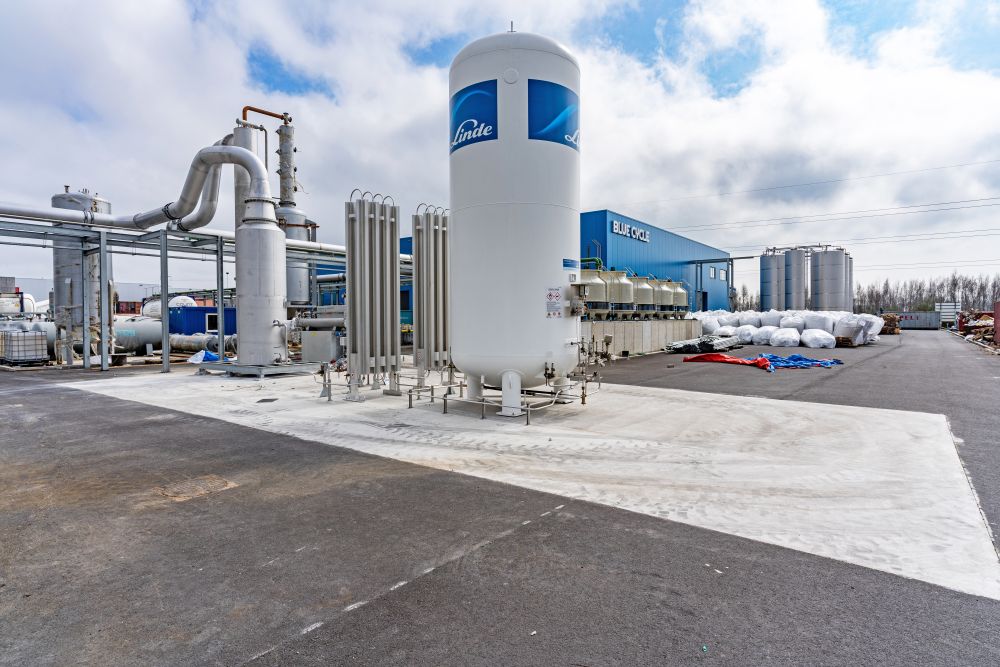
Earlier this year, Blue Cycle opened its first plant in Heerenveen. This factory is set up to process plastic waste into oil, which can be used directly as a raw material for the production of new plastics, or after an additional pre-processing step. The technique used to do this is called pyrolysis. That is heating materials at elevated temperature in the absence of oxygen.
Blue Cycle has developed a new pyrolysis technique to also take on a plastic waste stream that used to belong to non-recyclable plastics. 'And we use the non-condensable gases from the pyrolysis process as fuel in the process. We only need to start up the plant with natural gas. When the pyrolysis gas is created, the gas burners can be turned off,' said Eric Langedijk, director and co-founder. 'So the process is also completely self-sufficient.'
Chemical and mechanical recycling
'Plastics are actually a byproduct of fuel production from petroleum,' Langedijk explains. 'So when you bring those plastics back to oil, you are replacing the fossil resources you use to make fuel and plastics. In that sense, the oil we make is a raw material and therefore also circular.
Blue Cycle's way of working is called chemical recycling. Opposed to this is mechanical recycling, which, simply put, involves sorting and washing plastic by type, and turning plastic back into plastic. Mechanical recycling is cheaper, but has limitations. For example, it cannot be recycled indefinitely; chemical recycling can. Much plastic that is mechanically recycled still ends up in a linear process, whereas chemical recycling is fully circular. However, mechanical recycling is ranked higher than chemical recycling.
And with that, Langedijk gets to the heart of the first problem. 'Plastic producers are responsible for recycling their products. Agreements have been made about that with the government and the implementing organization is Nedvang. They own and are responsible for processing. And they have been given a target by the government that 50% must be recycled. So because chemical recycling is lower qualified, we don't get those waste streams because they get that percentage faster and easier through mechanical recycling. This is because the pressing of a low-grade product counts for 100% as recycling, and no account is taken of the CO2 impact or the reduction in the use of fossil raw materials. What's more, much of the mechanical recycling takes place abroad, where, for example, roadside posts and street furniture are made from it.'
And so an absurd situation arises for Blue Cycle. 'Our plant in Heerenveen is right next to waste processor Omrin. But they are not allowed to give us plastic waste, because they don't own it. We have to get it from Germany and England, where they say, 'Sure, we still have a lot of Dutch plastic lying around here that you can use ...'," Langedijk says. 'There is a government plan on chemical recycling, full of ambitions and goals, but without any regulations, implementation plans or anyone who should be responsible for it. And there is no politician or official who wants to burn his fingers on that.'
The mystery of end-of-waste status
This is the first major hurdle for Blue Cycle, but there are other issues at play. "The oil we make comes from waste streams, so formally our oil is considered waste. That means refineries are not allowed to buy our oil unless we get end-of-waste status. But to this day, I can't find anyone within the government who can grant us that status. You are constantly sent from pillar to post. Another company was finally able to get it by applying for a legal ruling, so we thought: great! They do pretty much the same thing, so that ruling applies to us as well. But you guessed it, it doesn't,' Langedijk continues. 'We had to apply for those ourselves. The problem with that is that nothing is being processed at the moment due to lack of time. The result is that we now have seven containers of oil on our property that we can't do anything with.'
We only need to start up the plant with natural gas. When the pyrolysis gas forms, the gas burners can be turned off.
Eric Langedijk
New factories
Despite all the barriers, there is still plenty of hope on the horizon for Blue Cycle. 'We have applied for a JFT grant, for the construction of a new factory in Delfzijl. We hope to get a decision on that this month and then we can get to work applying for all the permits,' says Langedijk. 'In addition, we are in the process of setting up a factory in Slovakia. Those permits are already in place, as is a factory hall. There is also a lot of interest from Germany, but those plans are still somewhat less concrete.'
At least that confirmation feels good to Blue Cycle. 'We had an Italian delegation over the other day and they were equally enthusiastic. Fortunately, they are eager to jump abroad. The world does not stand still. When we talk to oil producers, they all want our product. That gives us hope and motivation to further develop Blue Cycle and thus contribute to solving our global environmental problem.'
End-of-waste status
The regulations surrounding end-of-waste status are a thorn in the side of many plastic recycling entrepreneurs. It deserves national attention because plastic recycling is essential to the resource transition, in which we no longer want to use new petroleum for our products.
Maaike van Heeren, Chemport Europe program manager
