
NOM exists half a century this year. That makes it a year younger than Eemshaven, which celebrated its golden jubilee in 2023. Almost peers, they are similar, can learn from each other and help each other move forward.
Oil crisis it was, with car-free Sundays and Farce Majeur. And that same year, 1973, also saw the opening of the Maasvlakte, the large industrial area of the Port of Rotterdam. Not an ideal time for the start of a new industrial port for petrochemical activities in the north of Groningen. And yet Eemshaven kept its promise, even if it took a little longer. On its fiftieth anniversary, it is flourishing.
Development company, government, port authority, we consult with each other a lot and it is bearing fruit. Mainly because we all want the same thing. And that remains the case.
Cas König, Groningen Seaports
'And we celebrated that well,' says director Groningen Seaports Cas König. 'With directors was valuable, but especially the open day was brilliant. Many more people attended than we had expected. Many of them were people who had been involved in one way or another in the development and growth of Eemshaven. Suppliers, former employees of companies here, everything. I feasted my eyes and was struck by the pride with which they spoke about Eemshaven.
The establishment of NOM is essentially a direct consequence of the difficult time in which Eemshaven was born. While the port was still being built primarily because of the strong growth of (heavy) industry in the 1960s, NOM was, as it were, a response to the decline a few years later of that same industry. Director Dina Boonstra: 'You could say that the first goal was to prevent large employers from falling over. It was deep crisis.'
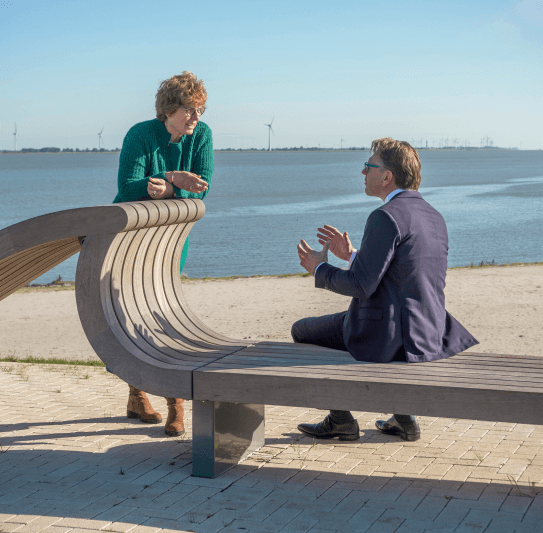
Fifth director
Almost fifty years later, it is no longer necessarily about big employers and certainly no longer about rescuing companies. NOM focuses more on development, on helping small and larger companies grow up. Although the acquisition of "big boys" to the Northern Netherlands is still important. That includes innovative startups. And that is typically something in which Eemshaven and NOM work closely together.
Dina Boonstra: "We too are celebrating a nice party next year. Such an open day seems wonderful, but that is difficult for us. Because: where should you do that? We are there for the whole of the Northern Netherlands. But we do want to approach and get together as many people as possible who have been involved with NOM over the past half century. Apart from that, a whole program is already being set up. Two years ago I already had a lunch with my predecessors. The talks there are part of publicity in the jubilee year. By the way, did you know that I am only the fifth director of NOM? Extraordinary, isn't it?
While Eemshaven developed from a petrochemical industrial port into a transhipment port and now an industrial port focused on (offshore) energy and data, NOM did not stand still either. Maintaining employment was the first credo, i.e. attracting companies. Back then, investing was more important than developing. That shifted in the late 1990s.
Dina Boonstra: "Development became increasingly important from then on. We wanted to help existing, often start-up companies move forward quickly. This can be done through investments, but also by offering advice and a network. And that is still one of our main pillars today. We are always looking for gems that we can help shine. It still surprises me how many of those gems there actually are in our area.'
Linked
Essentially the same applies to Eemshaven, where the focus in recent years has clearly been on greening, data and energy. Cas König: 'That green course is definitely going to pay off. You can already see that it has brought us to the attention of companies. They are looking for a place to scale up their sustainable activities. But there is almost no space left for that in the Netherlands. We still have land.
This is typically something that NOM also uses in the acquisition of companies, as well as sustainable startups, pilot plants and innovative companies: we have the space. The energy supply in and around Eemshaven is invariably a trigger for new business activity, as are the strong networks, among other things. König: "We started the upward trend years ago and it will continue for some time. This is largely due to the good cooperation between Eemshaven and NOM. As a result, wonderful companies have come this way. We usually hear back - when we ask why they chose us - that they are impressed with how we are all linked here. Development company, government, port authority, we consult each other a lot and that bears fruit. Mainly because we all want the same thing. And that remains the case.
Dina Boonstra: 'Above all, don't forget data. Internet is very important for the Northern Netherlands. That already came about when Groningen was home to KPN Research. Even now startups that can be traced back to that organization are still emerging. The founders of those days are now investing in new ventures. This creates a beautiful ecosystem to which we also like to contribute.
The parallel with Eemshaven is easily made in that area. The presence of space, professionals, cooling water and green power made it an attractive place for data centers. 'In the beginning people were somewhat scornful of that,' König says. 'Like: costs a lot of energy and space, but delivers little. Fortunately, that image has changed somewhat. Everyone can now see that such a large data center generates a lot of extra activity and a lot of employment'.
Circularity, sustainability, greening. It just has to be, and as soon as possible.
Dina Boonstra, NOM
Living Labs
So opportunities abound. Eemshaven offers them to entrepreneurs. NOM helps both those entrepreneurs and Eemshaven by talking to attractive parties who want to establish themselves in the North. In recent years, the 'living labs' in particular have attracted attention in this regard. Innovations have room to mature in the Northern Netherlands, especially in Eemshaven. What works on a lab scale can be tested on a larger scale in North Groningen.
This is the direction that both NOM and Eemshaven are choosing for the (near) future. König: "We are looking more at startups and scale-ups that have something unique. We want to give them a chance to develop and innovate here. Avantium is a good example. We really help them on their way. Ultimately, it is perhaps even more about the spin-off that we expect. It will generate new activity, sustainable activity.
When it comes to living labs, NOM looks at the entire North. Wetsus in Leeuwarden is one such example, the plastics cluster in Heerenveen is another, as is green chemistry in Emmen. 'And Astron in Dwingeloo, we also see opportunities there,' says Dina Boonstra. 'They have been working with data and AI there for years at a world-class level. We think young, innovative companies can develop around it.'
The North is facing a lot. The magic word now is "transition. And that - certainly at the beginning of the next half century - is what NOM and Eemshaven will continue to be about. König: "We are really living in a time of transition. We are now taking the basic steps for the greening of industry. It is now a matter of making the right choices, and as far as I am concerned we must accelerate development. We see that as our challenge.'
Dina Boonstra agrees. 'Circularity, sustainability, greening. It just has to happen, and as fast as possible. But also in the digital world and in the field of health we are going to face big challenges. These must be the years of breakthroughs as far as that is concerned. To achieve these we have another difficult task, both Eemshaven and NOM: we must ensure that legislation changes along with us. Because sometimes great ideas come up against a legal wall. And we really don't have time for that now. That's what we all have to learn hard now: how to switch effectively in transitions. I hope that fifty years from now we will be able to look back and say: we did a great job back then.