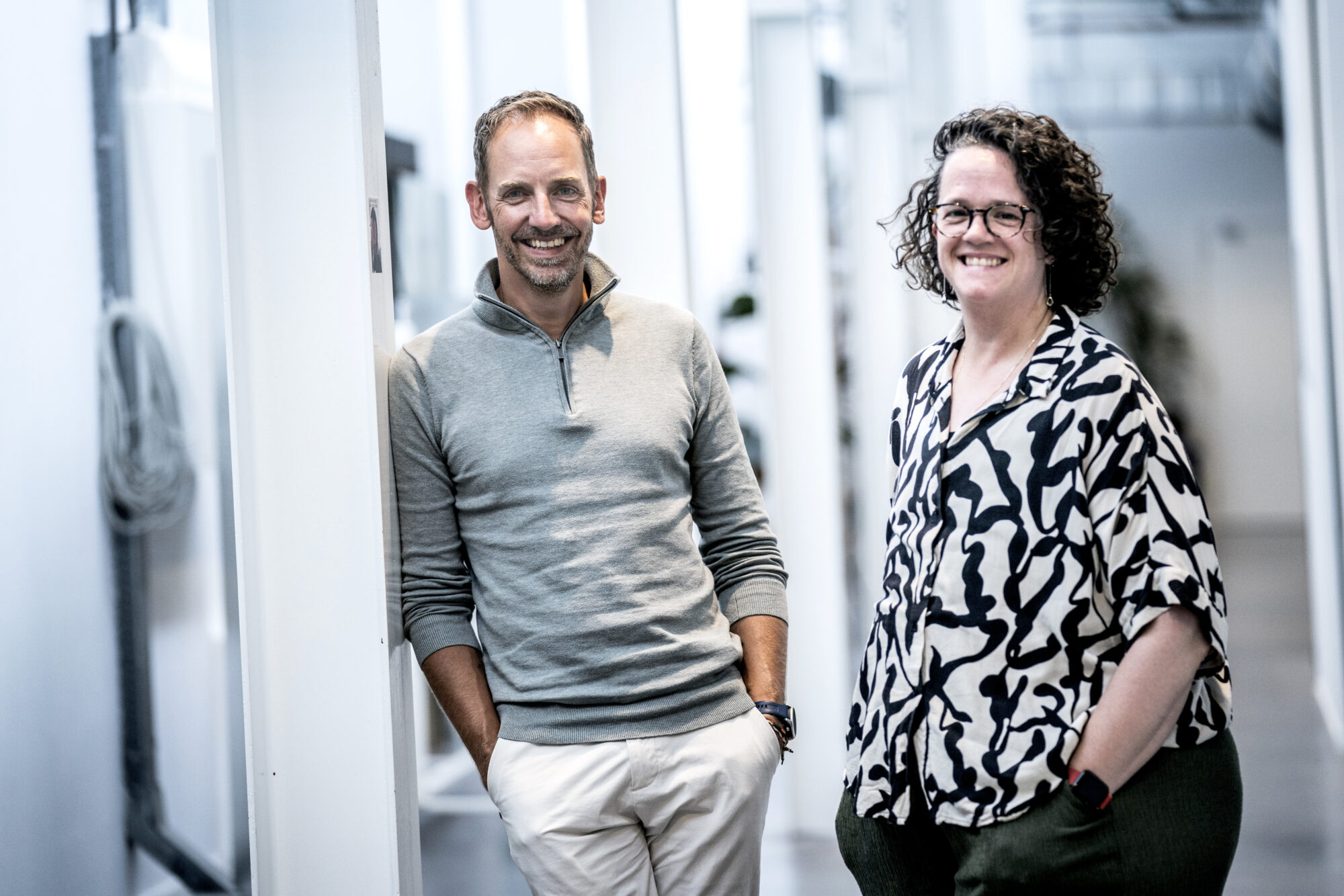
Companies that value their mission and social significance can be driven away from it by the power of purely money-driven shareholders. That's why steward ownership is an interesting legal form for companies that want to secure their heart for the future. How it works and why it's a good move? We asked communications provider Voys, which was recently allowed to call itself "steward owned.
Last fall, various media outlets were already reporting that Mark Vletter was “giving away his multimillion-dollar company.” That was when Groningen-based Voys announced its decision to adopt steward ownership. And now—after a year of intensive groundwork—the new structure is fully in place, while in day-to-day operations at Voys, very little has actually changed. “The biggest difference is that I’m now sitting at the table here as an appointed director and no longer as the owner,” says Mark, who is pleased that everything Voys stands for is enshrined in a corporate structure where mission and impact are guaranteed to remain the guiding principles.
A logical step
To the outside world, Voys' move was big news, but internally, steward ownership appears to be primarily a logical extension of the self-managing way the organization is set up. 'Already about ten years ago, Ben (co-founder Ben Hoetmer, ed.) and I had this direction in sight,' says Mark. 'It is the last formal step in a process of self (management). Voys has never felt like my property or merit. Our company was built by all the people who play or have played a role here. Everything is about interplay, including with the relationships that purchase our services and the economic and social context in which we operate. Yes, Voys is a multimillion-dollar company, but for me what is really significant is in other values.'
Mark refers to Voys' core mission: connecting people equally. And to such essentials as providing jobs in the region, educating the new generation, closing the digital divide (through the 48percent.org foundation) and experimenting with control. "Everything we do here comes from intrinsic motivation," Mark points out. 'That is our strength, although we are well aware that it is a fragile strength. In a sale or IPO, focus on shareholder value can affect the whole dynamic, and too often we see examples where that leads to negative effects in the company and for the environment. That's why we chose steward ownership; that's the best way to firmly anchor our thinking for the future.'
Robust and stable
Research on steward ownership shows that companies with this legal structure are more resilient, more stable, and more closely connected to their local communities. “Denmark is home to many pioneers, and steward-owned companies there also weathered the COVID-19 pandemic better,” says colleague Pollien van Keulen, who, as an impact strategist at Voys, led the entire transformation process with support from We Are Stewards. “Companies that consciously choose this model appear to be more successful in the long term. That’s because voting rights and economic rights (return on investment, ed.) are separated from one another. This prevents shareholders from using their influence for personal financial gain and ensures that the company’s mission always guides decision-making.”
'The legal ownership of Voys is now housed in a foundation,' Pollien explains. 'In it, three voices are represented: the colleagues, the customers and the thought leadership. They jointly appoint the directors of the Voys group, in this case Mark and Ben, who must submit all decisions with an impact on the direction and/or structure of Voys to the stewards. Two other foundations have been set up for economic law, within which agreements have been made about profit and return. In that structure there is also room to compensate shareholders or former owners, but without allowing them to turn the company's knobs. Profit is intended for the growth and continuity of Voys and to generate social impact.'
Making an impact
Yes, even steward owned companies are 'just' commercial and strive for profit. Not as a goal, but as a means to strengthen the company's mission. 'There are sometimes misunderstandings about that,' Mark and Pollien note. 'The foundations required for steward ownership evoke the association with idealistic organizations or social enterprises. Voys does pursue certain ideals and we like to contribute to broad economic-social prosperity, only our base is commercial. The twist with steward ownership is that everything is about making an impact from your mission. Because that motivates us many times more to perform than achieving ever higher stock prices and enriching a select group of shareholders.'
'We all see that a purely money-driven way of working has a negative impact on people, the environment and the original motives of entrepreneurs,' Pollien appoints. 'Yet change is slow, because economically we are still stuck in the paradigm that companies perform well mainly when their shareholders steer for profit maximization. Steward owned companies show that things can be done differently and in this Voys would also like to be an example.' Mark adds: 'This form of self-management stimulates mission- and values-driven entrepreneurship, a development that also demands something from investors. There is still a step to be made in this regard. Shareholders are used to being in control, whereas in steward-owned companies they primarily play a subservient role. They invest in a shared mission and thus give their trust to the company itself.'
Solid basis
Voys has already amply proven itself and did so without ever having to call on investors. Mark: 'Because we have since built up a million-dollar value, that did make the step to steward ownership a bit more complex. Especially tax-wise. This change seemed prohibitive for us at first, until a favorable change in the law came along last year.' From then on, Pollien worked with tax and legal specialists to create a solid steward structure, completely tailored to Voys. 'The advice and associated paperwork surrounding this turnaround was an investment in itself,' says Mark. 'But it was necessary to guarantee the future of this company, even if I am no longer involved later.'
Mark will remain active in the company for at least the next four years. 'I'll keep doing what I've always done, but it feels different now that the company really belongs to itself. It's a nice idea that the philosophy of Voys can continue to exist even without me, because the stewards guard our company mission. So we have a solid foundation for the future, with still enough flexibility to move with changing realities. Because room for entrepreneurship and experimentation is part of the evolving nature of Voys. As long as it serves our mission.'
Curious if steward ownership is something for your company? Contact We Are Stewards for information and advice. Good to know: entrepreneurs who would like to see their efforts and risks taken properly rewarded - now and/or in the future - or who are afraid to surrender their pension pot, can make excellent arrangements within steward ownership. As long as the company's existence and mission remain intact.
Because steward ownership contributes to a sustainable regional economy, NOM and other ROMs in the Netherlands are also exploring the benefits of this form of business. This includes examining what innovations in the financial system are needed to invest - in line with their own objectives - in companies that are steward-owned.
wearestewards.nl