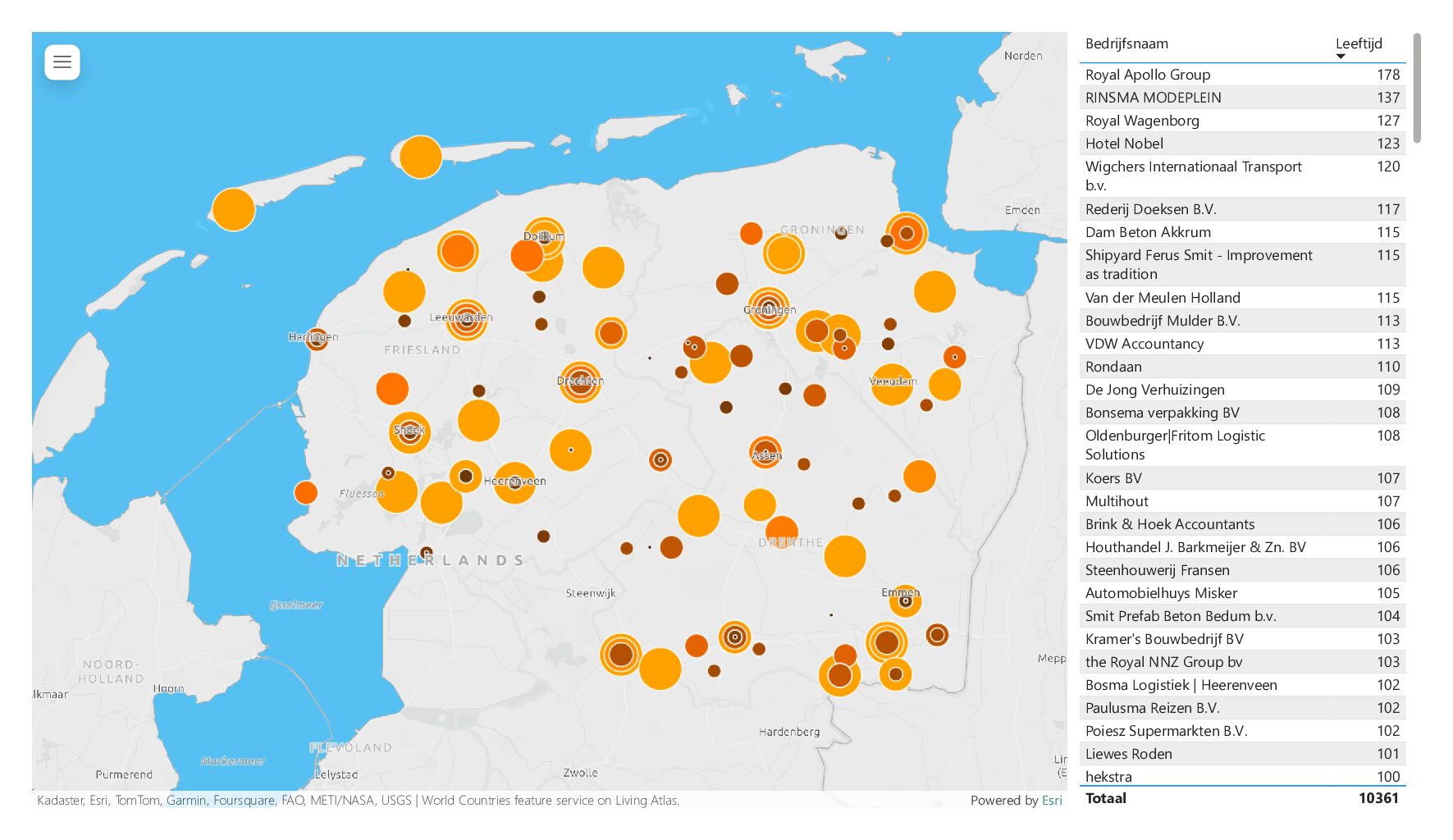
The Northern Netherlands has a surprising number of family businesses and there are interesting leaders among them when it comes to innovativeness. How can other entrepreneurs in the region learn from them, in this challenging transition era? We asked Mira Bloemen-Bekx. As a lecturer in Regional Innovation Capacity, she contributes to a stronger innovation climate and discovered the value of family businesses in her research.
As a farmer's daughter, Mira understood the principle of a family business at an early age, and the link with entrepreneurship has proved to be a thread running through her career. 'In my current role as a lecturer at the Hanze, I combine content with the dynamics of the entrepreneurial environment,' she says enthusiastically. 'In this way I can make a difference to the development of the Northern Netherlands from research and knowledge.' Mira speaks highly of entrepreneurs. 'It deserves respect that these people play a crucial role in the living and working climate of our region at their own risk. It is underestimated what is involved. Especially in these times, when many issues are simultaneously at play around themes such as energy, circularity, infrastructure, digitalization, grid congestion and talent retention.'
Survival mentality
Mira's most recent research focuses on innovativeness in work practices. In doing so, she explicitly sought out family businesses, because they are deeply rooted in the region. 'On average, they have a longer history, some even more than a hundred years. If you last for such a period of time, you clearly have innovativeness, and that's what we want to learn from. Moreover, family businesses from the northern region appear to be more innovative than similar businesses elsewhere in the country. We haven't researched why that is, although based on many conversations I can indicate that it has to do with a combination of self-reliance and the work ethic in this region. There is a certain survival mentality.'
'Because of the relatively greater distances in the North, companies have traditionally been used to doing things themselves, with loyal employees from nearby,' Mira explains. 'That self-reliance makes creative and innovative, although there is also a downside: it makes companies less open, while the challenges of our time call for more cooperation in the region. And in large parts of the Northern Netherlands, SMEs do not naturally meet. While we see that innovation thrives in places where companies are closer together or know how to find each other. This is a great challenge, which is why we are going to use the results of our research, among other things, to set up a learning program for entrepreneurs in the Northern Netherlands, in which they can learn from and with each other. And family businesses are also important sources of inspiration in this.'
Strong family, strong company
Data specialists at NOM identified more than 250 companies in the Northern Netherlands that fall into the family business category. “They come in all shapes and sizes, just like the various definitions that exist for this type of business,” the lecturer notes. “Some families play a behind-the-scenes role, while others are actively in charge and also consciously position themselves as family businesses.” According to Mira, there are notable innovators within this category in every northern province, such as the Bork Group in Drenthe, Boom Publishers, and the Royal Apollo Group; in Friesland, Damstra Installatietechniek, Douma Staal, and Royal Smilde; and in Groningen, the young family business Lode Holding, NNZ, and Wagenborg.
What makes these types of family businesses so powerful in innovation and what can other entrepreneurs learn from them? 'Strong families have strong businesses,' Mira discovered. 'That has to do with a high level of commitment, but especially with good communication and openness to development. Because there are also family businesses where ties and traditions are actually hindering. Innovativeness is about the art of combination: managing the day-to-day operations and being concerned with the long term. Many entrepreneurs get stuck on the short term, while true innovators, in addition to serving current market demands, are already anticipating the future. This is how they ensure development and timely innovation.
The world of tomorrow
According to the lector, family businesses are naturally more concerned with generations, the long term and co-responsibility for their environment. 'This is why stewardship, sustainability and social impact are in many cases just as important to these companies as economic goals. At the same time, they understand that growth and profit are necessary to innovate to ensure their survival. You see this combination in other companies as well, although innovative family businesses are more often distinguished from more commercially driven entrepreneurs by their intrinsic and social motivation. They are more consciously concerned with values, meaning and direction based on their vision of tomorrow's world.
'In this age of transition, the great challenge for all companies is to think - more actively than ever - about tomorrow's world and their role in it,' Mira continues. For entrepreneurs in established SMEs, the issues of the day often consume so much of their attention that they hardly get around to thinking about the longer term. Even though it is part of their job to keep learning and putting out feelers. Because those who don't keep up, put a brake on the company. Innovation is about the ability to develop yourself as an entrepreneur, grow your people and constantly innovate products, processes and technologies together. This is the only way for companies to stay ahead or keep up in this rapidly changing world. And that requires a conscious focus on change.'
Fine-tuning
By researching innovativeness in work practice, the lector knows how important it is to organize time and rest for that focus on change. 'We have seen that innovativeness consists of a flywheel of the factors leadership, organization, innovation, people, finance and cooperation within the company and with partners outside. All knobs that entrepreneurs can turn. However, you have to tune in to what the company needs and you really have to sit down for that on a regular basis. A selection of northern entrepreneurs will soon be able to do that within the learning process we are setting up from the Hanze. Here we use the knowledge and inspiration of frontrunners from the region to allow the leading pack behind them to develop further.'
Other SMEs who want to keep up can also be inspired by the research findings of the lectorate Regional Innovation Capacity. Mira mentions three important competencies for innovative capacity: sensing, seizing and reconfiguring. 'In plain language, by this we mean sensing what is going on in terms of developments - from substantive trends to legislation and regulations - and consciously choosing what to go along with or not. Focus is necessary, otherwise you will get lost in it. Then it is important to make concrete choices, and after that it comes down to perseverance. Real innovation only comes about when you manage to complete the innovation processes you have started. And companies do not have to do that all by themselves. Too much self-reliance isolates. Seek each other out, discover common interests, exchange and thus increase your own innovative capacity and that of our region.