
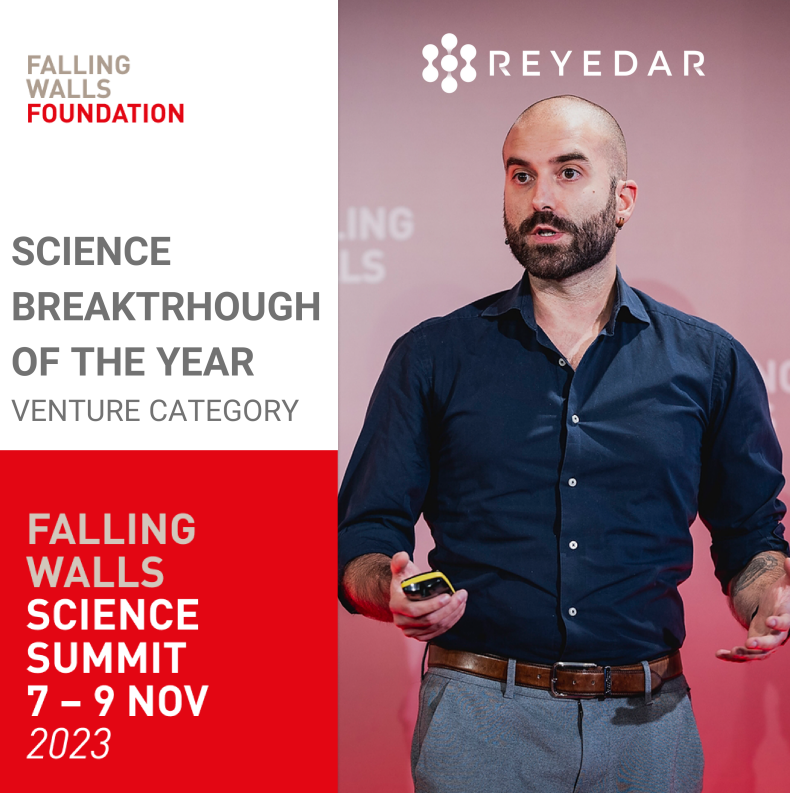
Being named Science Breakthrough of the Year 2023. It is reserved for few. During the prestigious Falling Walls Science Summit in Berlin, that honor recently fell to Reyedar, a Groningen MedTech startup that is co-funded by the NOM.
Surprised and elated, Alessandro Grillini walked up to his associate Camiel van Vught this summer. The founder and CEO of Reyedar had just before been told that their company was among the 25 winners of the Falling Walls Venture competition. A competition for which as many as 137 promising Science startups from 33 countries had applied.
And so last November 7, the Groningen startup was allowed to compete for the title Science Breakthrough of the Year 2023 in the MedTech category at the Falling Walls Science Summit 2023 in Berlin. A coveted title, for sure. And above all, a recognition and appreciation for the groundbreaking solution Reyedar has developed for the early detection of degenerative diseases such as Glaucoma and Parkinson's.
Scientific vanguard
Long story short: after a blazing pitch by Alessandro, Reyedar actually managed to win the title. According to the jury report, Reyedar is the ultimate example of a startup that combines research expertise with excellent entrepreneurship in the best possible way. Fine words at the annual event that is as prestigious as the prize itself. The Falling Walls Science Summit is a three-day gathering where international scientists working at the forefront of their fields come together to explore scientific breakthroughs and emerging trends.
Falling Walls Labs
For Alessandro, it was his second participation in Berlin. Four years earlier, in 2019, he participated from his doctoral research at the UMCG in Falling Walls Labs, an international platform for students and "early career" professionals. At the time, he presented in the German capital the results of his research into the possibilities of using eye tracking to record eye movements and then, based on deep learning, extract all kinds of valuable information about the physical state of the human body. What do eye movements tell us about a person's eye function, brain function or cardiovascular housekeeping, for example?
Also in 2019, Alessandro walked away with the win. But perhaps even more appealing is its recent success at Falling Walls Venture 2023. As a Science startup, Reyedar, a spin-off from the Department of Ophthalmology at the UMCG, thereby demonstrates that the company has what it takes to further develop breakthrough technology that can have a positive impact on the health and well-being of billions of people worldwide.
Slumbering
Degenerative diseases usually develop dormantly and unnoticed. Often you only find out when it is already too late. To prevent irreparable damage, it is therefore crucial to detect the disease early. However, current screening methods tend to be invasive, time-consuming and unreliable. With dire consequences for the healthcare system.
'In the method frequently used in hospitals, you have to fixate on a point of light,' clarifies Camiel van Vught, CCO and co-founder of Reyedar. 'In the periphery, all kinds of lights then light up and you have to press a button to indicate whether or not you have seen a light. Only: your eye reflex is trained to immediately look as soon as something occurs in the periphery. So you have to suppress that reflex, and at the same time, it is never entirely certain whether someone actually perceived the light when they pressed the button. That makes the test, which can easily take half an hour, not only burdensome and time-consuming, but also very subjective.'
Objective data
Reyedar, using eye-tracking technology, actually reverses the pattern. It looks at what the eye does and does not perceive. That way you give the eyes back the natural reflex, so to speak. 'You get glasses with eye tracking sensors on,' Camiel explains. 'While you follow a moving ball on a screen, the glasses register the eye movements with more than 200 images per second. Because our test takes only two minutes, a total of about 24,000 eye movements are thus recorded. In other words, a lot of objective data about the accuracy and responsiveness of the eyes is generated. We then use deep learning, a form of artificial intelligence, to recognize patterns from all that information and detect degenerative diseases at an early stage.'
Opticians
Combining deep learning and eye-tracking technology is primarily intended to offer hospitals a good alternative to the way visual field examinations have been performed for years. Indeed, the added value of Reyedar's solution is obvious: more objective data, pattern recognition using deep learning and a huge time savings.
'But because the test is so approachable, patient-friendly and fast, it can also easily be used outside the walls of the hospital,' Camiel emphasizes. 'For example, as an additional service with eye care specialists such as opticians. Especially now, given the developments in the eye care market, primary eye care is going to play an increasingly important role within opticians' stores.'
Positive response
Back to the Falling Walls Science Summit in Berlin. Has winning the title Science Breakthrough of the Year 2023 already led to spin-off effects? 'Not very concretely yet,' Camiel confesses. 'However, Alessandro, the face of Reyedar, has meanwhile received a lot of positive response, especially from the scientific world. But we also notice that our investors, including NOM, think it's fantastic. After all, a title like this puts the company firmly in the spotlight. So there may be many wonderful things to come our way.'
Source photos: Falling Walls